

Pondering Self Sufficiency
Part IV: Situational Awareness and Self Defense

With the nation focused on Minneapolis and civil unrest, perhaps this is an opportune time to discuss the importance of situational awareness and self defense. Situational awareness is just knowing what’s going on around you and taking appropriate action to minimize risk. It is a continuous cycle of observing, orienting, deciding, and acting. This cycle, coined the “OODA loop” by U.S. military fighter pilot John Boyd, was designed to outmaneuver opponents during high-speed air-to-air “dog fights.” The OODA loop helps people recognize threats, assess risks, and respond appropriately.
To implement the OODA Loop:
Observe your environment. Wherever you are, use all five senses to figure out what is normal. Consider the noise level, speed of activity, behavior of people in the area, etc. Then...
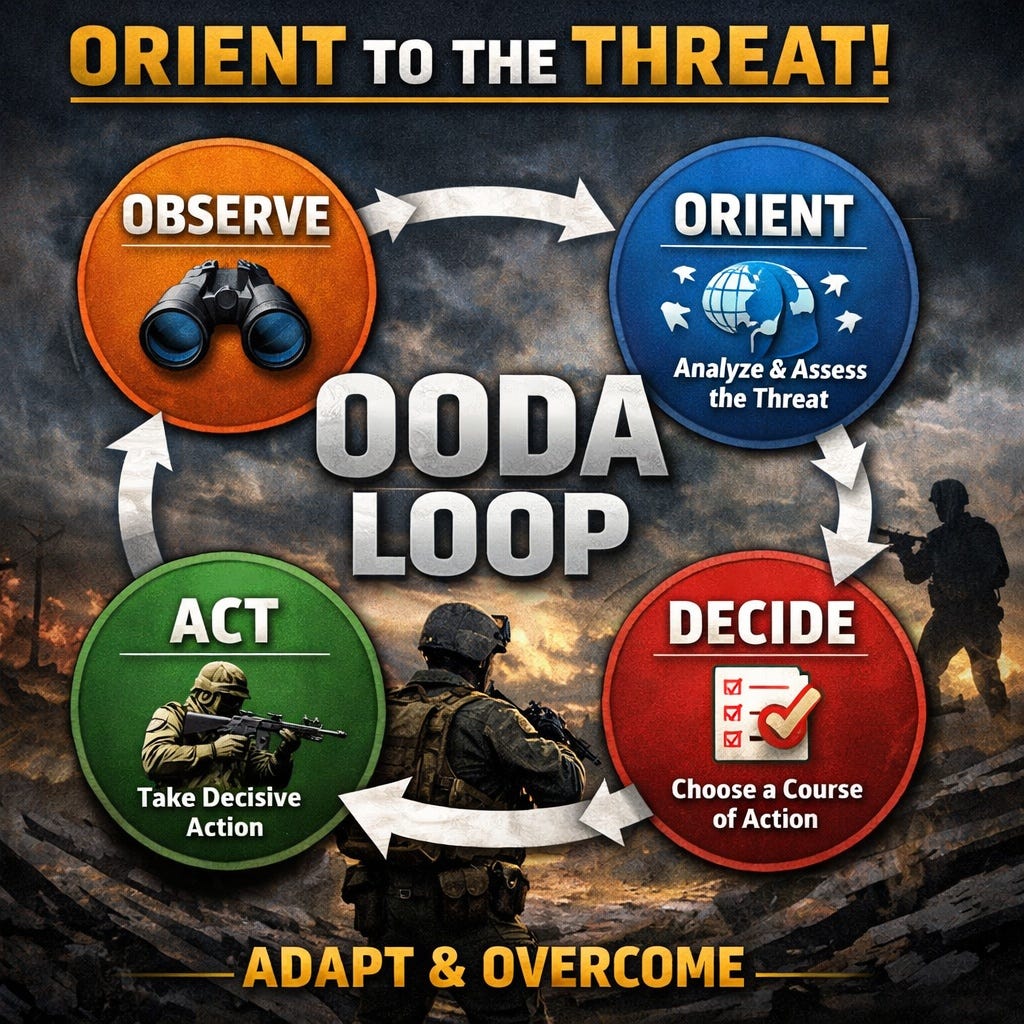
Orient to any abnormality or threat. Pay attention to things that differ from normal patterns or behaviors. Identify things that feel “off” and consciously acknowledge whatever triggered your internal radar. Maybe it was someone staring intently at another person – and I’m not talking about a Valentine’s Day dinner date. Maybe it was someone who seems irritable and is pacing or muttering to themselves. Perhaps it was someone wearing a heavy overcoat in the middle of summer. The human brain is designed to look for differences, anomalies, and change. Orienting is the opposite of a “no judgment zone.” Judge. Recognize things that aren’t normal. Learn to trust yourself. Then...
Decide what you’re going to do about the abnormality or threat. People don’t generally make the best decisions during a crisis, so have a plan before anything happens. Start thinking through “what if” scenarios. It will improve your reaction time in the event something goes wrong. Then...
Act on your decision. Adjust your behavior as necessary to achieve your desired outcome. This could be as simple as taking a step away from a situation or deciding to skip a shortcut through an alleyway. Once you’ve taken action, pay attention to any reactions and continue observing your surroundings. You’re right back to the first “O” in the OODA Loop.

There are several easy activities to increase your situational awareness and capacity for self defense:
1. Mental attitude is key. Embrace your will to survive and, if necessary, fight.
2. Be cognizant of your presence and stature. Stand up, talk, and walk confidently. Even if you don’t feel confident, fake it ‘til you make it. Bad guys generally look for easy targets. Don’t make it simple for them to select you out of a crowd.
3. Distraction = Vulnerability. Try to stay off of your phone in public places. Avoid wearing headphones, which block your ability to clearly hear your surroundings.
4. Leave space to maneuver – wherever you are. Maintain a personal bubble. When driving, don’t pull up too close to the car in front of you. Time and space are critical to self defense.
5. Know where entry and exit points are. For example, a restaurant will always have a main entrance. However, there is often another door that employees use. Sometimes it’s through the kitchen or at the end of a hall where the bathrooms are located. Be aware of those alternate locations. This allows you to remove yourself from a bad situation faster and avoid bottlenecks if there is a mass exodus.
Consciously paying attention to your environment, identifying and responding to things that are out of place, and trusting your gut, are invaluable skills. When implemented regularly, they can help you avoid or successfully navigate dynamic or undesirable situations. Hopefully great situational awareness is all you will ever need to stay safe in life. However, I have found it is better to hope for the best and prepare for the worst.
In addition to improving situational awareness, I think it is important to consider tools and skills that enhance your ability to defend yourself. We like to think that the police will always be there to stop the bad guys. Unfortunately, especially during times of unrest, law enforcement may be tied up dealing with other situations.

A basic self defense class allows participants to practice getting out of uncomfortable situations in a safe environment. Although these techniques are useful for everyone, they can be particularly helpful for those who are smaller or lack the strength or mobility of potential aggressors. Many self defense courses also discuss how to deescalate situations and, when necessary, how to use common items like keys as weapons.
There are a variety of non-lethal self defense items that can also be used. These include pepper spray, tasers, and even unconventional or improvised weapons, such as a metal water bottle. Personal safety alarms emit piercing sounds to alert others in the area that something is wrong. This could be a good option for a responsible child or teenager.
Knives, batons, and guns can also be effective self defense items. Over half of U.S. states are “constitutional carry” states, which means government permission is not required to carry a firearm. There are other places, like Washington, D.C., where weapons of all kinds are heavily restricted. It’s important to understand local laws and ordinances in order to make an informed decision about how to best protect yourself. It is also important to be familiar with your weapon and to train regularly, especially if you are new to using it. There are a variety of organizations and companies that provide tactical training, which can help ensure your weapon doesn’t end up being used against you. It is critical to recognize that carrying a weapon is not just about self defense or individual rights; it’s about accountability, restraint, and discipline. A responsible owner avoids conflict, deescalates potentially violent situations, and only uses their weapon as a lifesaving measure of last resort.
On the home front, small additions can make a huge difference. Motion lights not only help you get to your front door with an armload of groceries, but can alert you to unexpected movement around your home. Cameras enable remote viewing of your front and back yard. Using wood or metal rods in sliding door tracks can make it harder to break in. An alarm system can notify the police or fire department if there is smoke or a window is broken. When it comes to active deterrence, nothing beats the sound of a shotgun being racked.
Familiarity with any tool is essential for effective use under pressure. So do yourself a favor and take action in the next week to improve your ability to defend yourself. Perhaps you can try situational awareness drills on your way into work or when you are grocery shopping. Perhaps you sign up for a self-defense class. Or maybe you register for a concealed carry permit. Whatever action you take, recognize that a journey of a thousand miles starts with a single step – and you just took one step closer to a more secure future. Take care and semper gumby!